
Product · Industrial Automation
Solenoid
Housing.
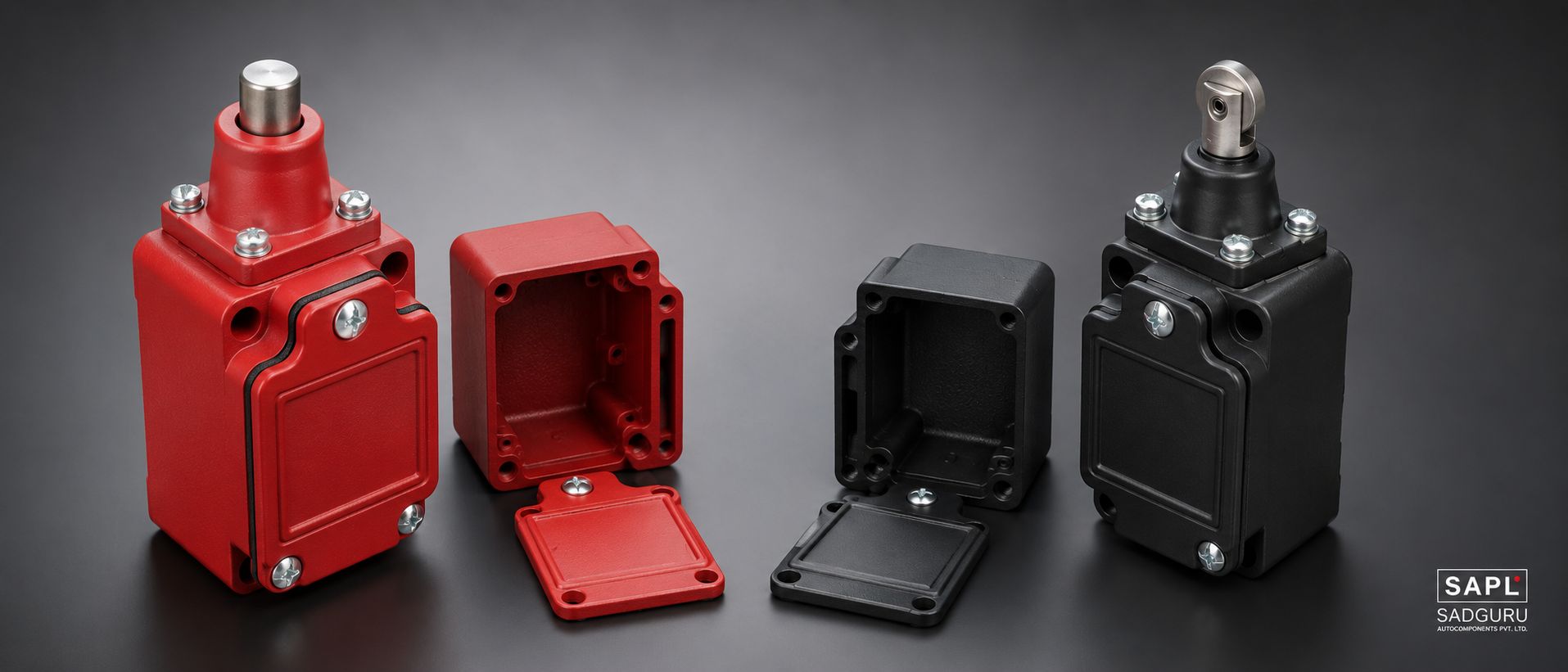
High-pressure die cast aluminium solenoid valve housings — precision bore for solenoid body, machined port threads, pressure-tight wall sections, and consistent dimensions across high-volume production for industrial fluid control applications.
Product Overview
Solenoid Housing
Solenoid housings are precision fluid control components that must meet demanding requirements on bore geometry, port thread accuracy, and pressure containment. The solenoid bore must be round and straight to hold the solenoid body in the correct position for reliable valve actuation. Port threads — typically BSP or NPT — must be fully formed and leak-free under operating pressure. And the wall sections between the bore and ports must be free of porosity.
SAPL produces solenoid housings on 180T and 250T HPDC machines using ADC12 alloy. The compact geometry and multiple-cavity tooling allow efficient production of high-volume requirements. All precision bores are machined post-cast on the VMC; port threads are cut with precision machine taps and verified with go/no-go gauges at 100%.
Pressure-tight integrity is verified by hydrostatic leak testing on first-article parts and statistical production samples. SAPL applies an anodic or chromate conversion coating where the operating fluid or environment requires corrosion protection beyond the standard as-machined aluminium surface.
Quality
Critical quality requirements
These are the characteristics SAPL controls and measures on every production batch for this component — and how they are maintained in the process.
Solenoid bore geometry
The solenoid body is a close sliding fit in the housing bore. Bore must be round (≤ 0.008 mm circularity), straight (≤ 0.01 mm cylindricity), and sized to H7. SAPL precision bores or hones the solenoid bore post-cast to achieve these tolerances.
Thread form and leak integrity
Port thread leakage is a common field failure in solenoid valve assemblies. SAPL uses precision machine taps with calibrated torque to produce full-profile threads, verifies every thread with go/no-go gauges, and confirms leak integrity by hydrostatic test at 1.5× working pressure on first-article.
Porosity between bore and ports
A porous wall between the solenoid bore and a port thread can create an internal crossflow path that bypasses the valve. SAPL validates this through cross-section metallographic inspection on first-article samples and monitors through hydrostatic leak testing in production.
FAQ
Common questions
Questions from procurement teams and design engineers about this component.
Ask a technical question →What bore diameter range can SAPL produce for solenoid housings?
SAPL currently produces solenoid housings with solenoid bore diameters from 10 mm to 50 mm. Bores are machined to H7 tolerance by precision boring or honing post-cast. Requirements outside this range should be discussed at the RFQ stage.
Does SAPL perform leak testing on solenoid housings?
Yes. Hydrostatic leak testing is performed on first-article samples at 1.5× the specified working pressure. In production, statistical sampling frequency is defined in the customer quality plan. For 100% leak testing, SAPL can integrate air-decay testing on the machining line.
What surface treatment is available for solenoid housings?
Standard supply is as-machined aluminium. For applications where the operating fluid or environment causes corrosion, SAPL can apply hard anodising (Al2O3 layer, 20–50 µm) or chromate conversion coating. The choice depends on the operating fluid compatibility and the required coating thickness.
Capabilities
Processes used for this component
High Pressure Die Casting
Five fully-automatic HPDC machines from 180T to 450T.
View capability →CNC & VMC Machining
Over 20 CNC turning centres and Vertical Machining Centres — including 4th-axis VMC for complex geometries.
View capability →Engineering Support
DFM analysis, alloy selection guidance, design review, and prototype samples — before drawings are frozen and tooling is cut.
View capability →Related Products
Other components in this programme
Mechanical Pump Housing
High-pressure die cast aluminium pump housings for automotive and industrial mechanical pumps — pressure-tight casting integrity, precision machined fluid ports, seal grooves, and mating flange faces.
Aluminium Electrical Enclosure
Die cast aluminium enclosures for electrical and electronic equipment — inherent EMI shielding, machined sealing faces for IP protection, cable entry bosses, and robust wall sections for industrial and outdoor duty.
Get Started
Sourcing solenoid housing?
Share your drawings — STEP, IGES, DXF, or PDF. SAPL will review manufacturability, confirm alloy and process, and respond with a technical and commercial proposal within 72 hours.