
Product · Consumer Appliances
Ceiling Fan
Top Cover.
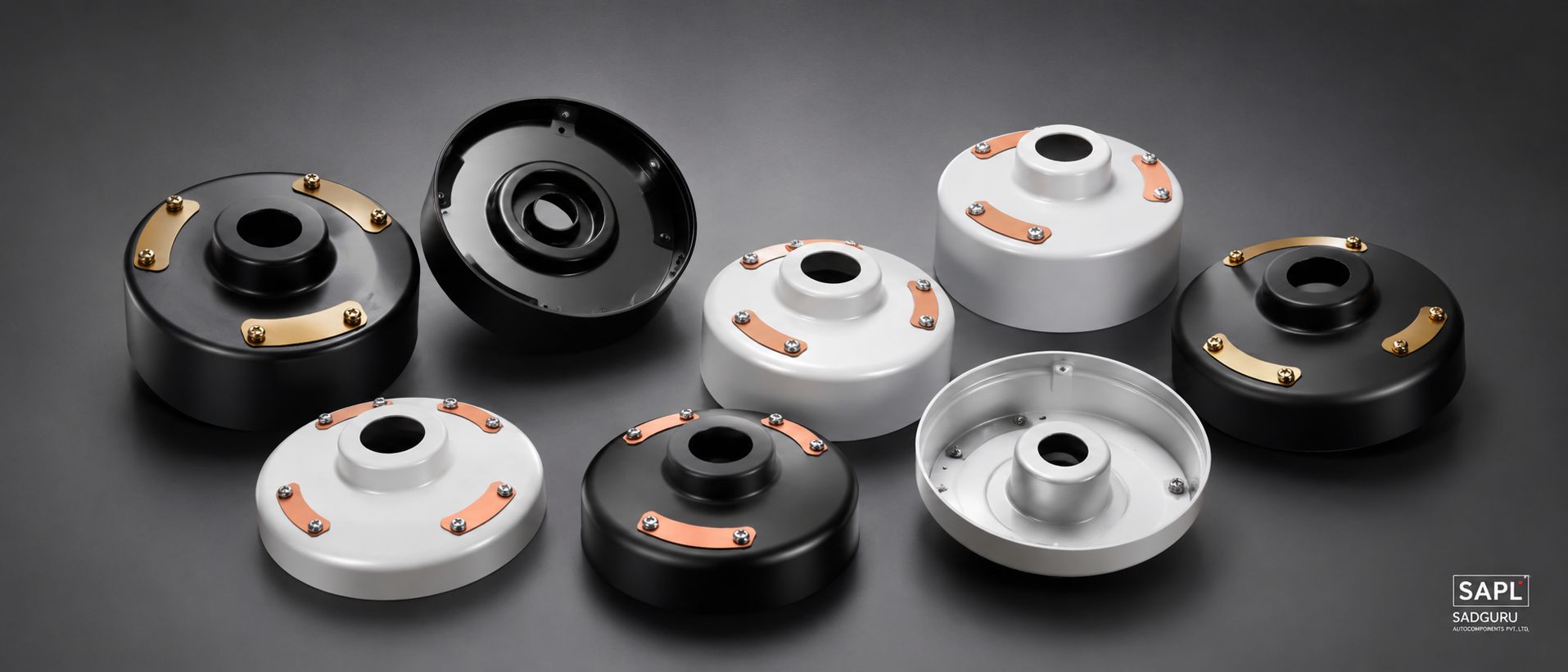
High-pressure die cast aluminium top covers for ceiling fans — precision blade-arm bosses, clean visible surfaces, and consistent dimensional accuracy across high-volume production runs.
Product Overview
Ceiling Fan Top Cover
The ceiling fan top cover is one of the most dimensionally critical components in the fan assembly. It houses the motor shaft bore, carries the blade arm mounting bosses, and presents the uppermost visible surface of the fan body. SAPL produces these covers on 180T and 250T HPDC machines using ADC12 alloy, which provides the combination of fluidity and strength required for thin-wall sections and precise boss geometry.
Blade arm bosses are cast to location tolerances of ±0.3 mm, with post-cast CNC drilling and reaming of the central bore to H7 where motor shaft fit is specified by the customer. The visible outer surface is produced to an as-cast finish suitable for direct powder coating — no secondary linishing is required under standard conditions.
SAPL manages the complete production sequence from die casting through CNC machining and powder coating, allowing OEMs to receive a finished, ready-to-assemble component rather than a raw casting. Monthly output capacity for ceiling fan top covers exceeds 40,000 pieces across standard and custom configurations.
Quality
Critical quality requirements
These are the characteristics SAPL controls and measures on every production batch for this component — and how they are maintained in the process.
Bore concentricity
Motor shaft bore must be concentric with the blade arm boss circle. SAPL machines the bore in a single CNC setup referenced from the boss PCD to maintain concentricity within 0.05 mm TIR.
Surface appearance
As the top cover is a visible component, cold shuts, flow marks, and shrinkage porosity at the surface are unacceptable. Die temperature and injection parameters are controlled to eliminate surface defects before the coating operation.
Boss flatness
Blade arm mounting faces must be flat within 0.2 mm to prevent blade wobble at operating speed. SAPL uses go/no-go gauging at 100% in-line inspection for this characteristic.
Coating adhesion
Powder coat adhesion is tested per ISO 2409 cross-hatch method. Nano-ceramic pre-treatment provides Grade 0 adhesion on all ADC12 substrates supplied by SAPL.
FAQ
Common questions
Questions from procurement teams and design engineers about this component.
Ask a technical question →What alloy does SAPL use for ceiling fan top covers?
ADC12 is the standard alloy for ceiling fan top covers. It offers excellent die-filling characteristics for the thin-wall sections and boss geometry typical of this component, and responds well to powder coating after nano-ceramic pre-treatment. LM24 is available where higher static strength is required.
Can SAPL supply finished top covers ready for assembly?
Yes. SAPL manages the full sequence: HPDC casting, deburring, CNC bore reaming, nano-ceramic pre-treatment, and powder coating. The component is delivered ready for motor and blade arm assembly, eliminating the need for secondary operations at the OEM facility.
What volumes can SAPL handle for ceiling fan top covers?
Monthly capacity for ceiling fan top covers exceeds 40,000 pieces per configuration. For programmes requiring higher volumes, SAPL will discuss tooling duplication and machine allocation as part of the initial RFQ review.
Capabilities
Processes used for this component
High Pressure Die Casting
Five fully-automatic HPDC machines from 180T to 450T.
View capability →CNC & VMC Machining
Over 20 CNC turning centres and Vertical Machining Centres — including 4th-axis VMC for complex geometries.
View capability →Powder Coating
5-tank nano-ceramic pre-treatment, two dedicated coating booths, 100% Dry Film Thickness inspection on every part.
View capability →Related Products
Other components in this programme
Ceiling Fan Bottom Cover
Die cast aluminium bottom covers for ceiling fans — matched to top cover geometry, with canopy mounting features and decorative visible surfaces produced directly from the die without secondary machining.
Fan Motor Housing
High-pressure die cast aluminium motor housings for ceiling and exhaust fans — precision bearing seat bores, stator fit diameter, and integral ventilation geometry produced in one casting with post-cast CNC machining.
Get Started
Sourcing ceiling fan top cover?
Share your drawings — STEP, IGES, DXF, or PDF. SAPL will review manufacturability, confirm alloy and process, and respond with a technical and commercial proposal within 72 hours.