
Capability
High Pressure
Die Casting.
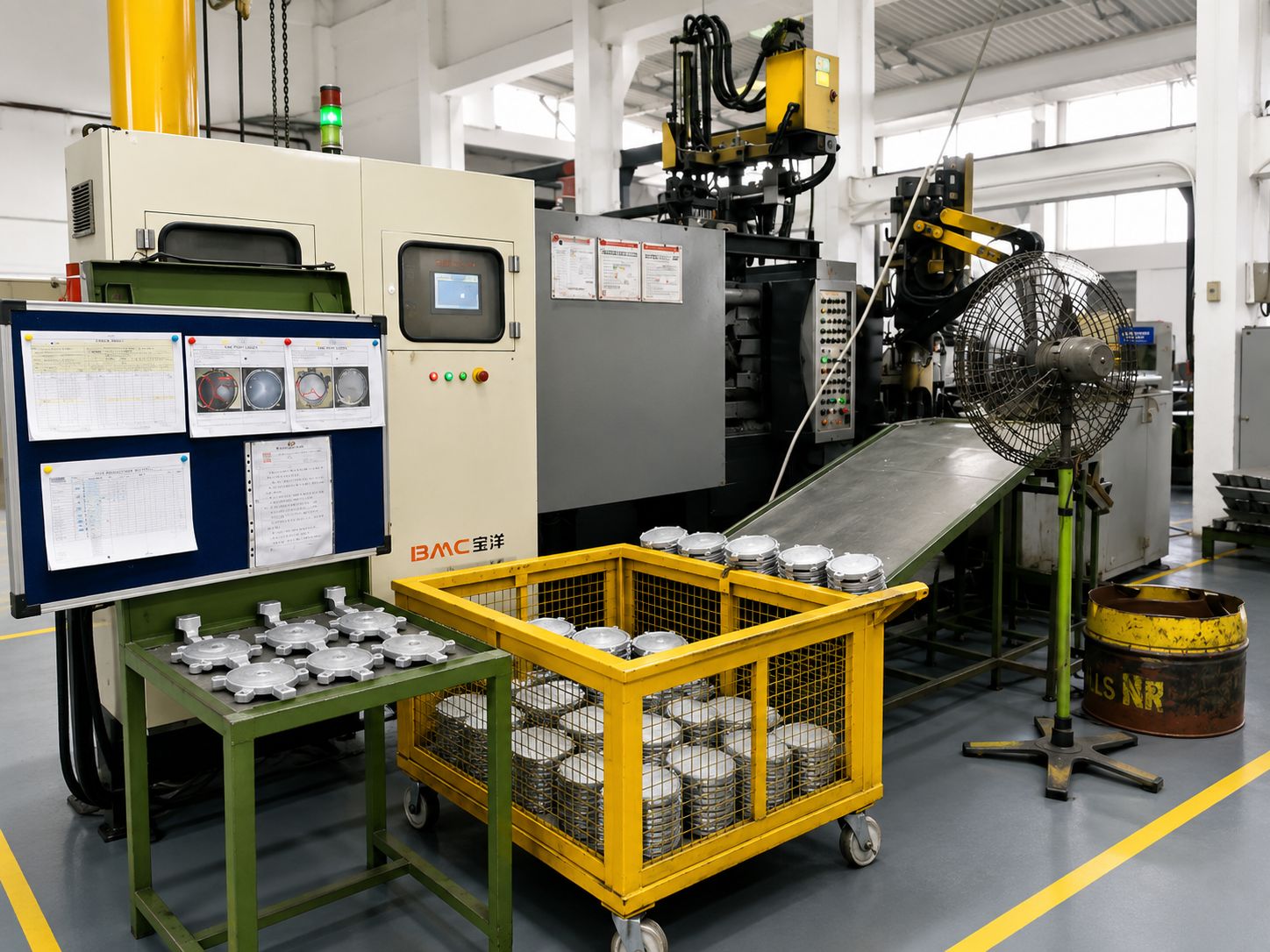
HPDC from 150T up to 700T. Producing 250,000+ aluminium castings per month in ADC12, A380, and LM24 — with real-time shot monitoring and full process traceability.
Overview
High Pressure Die Casting
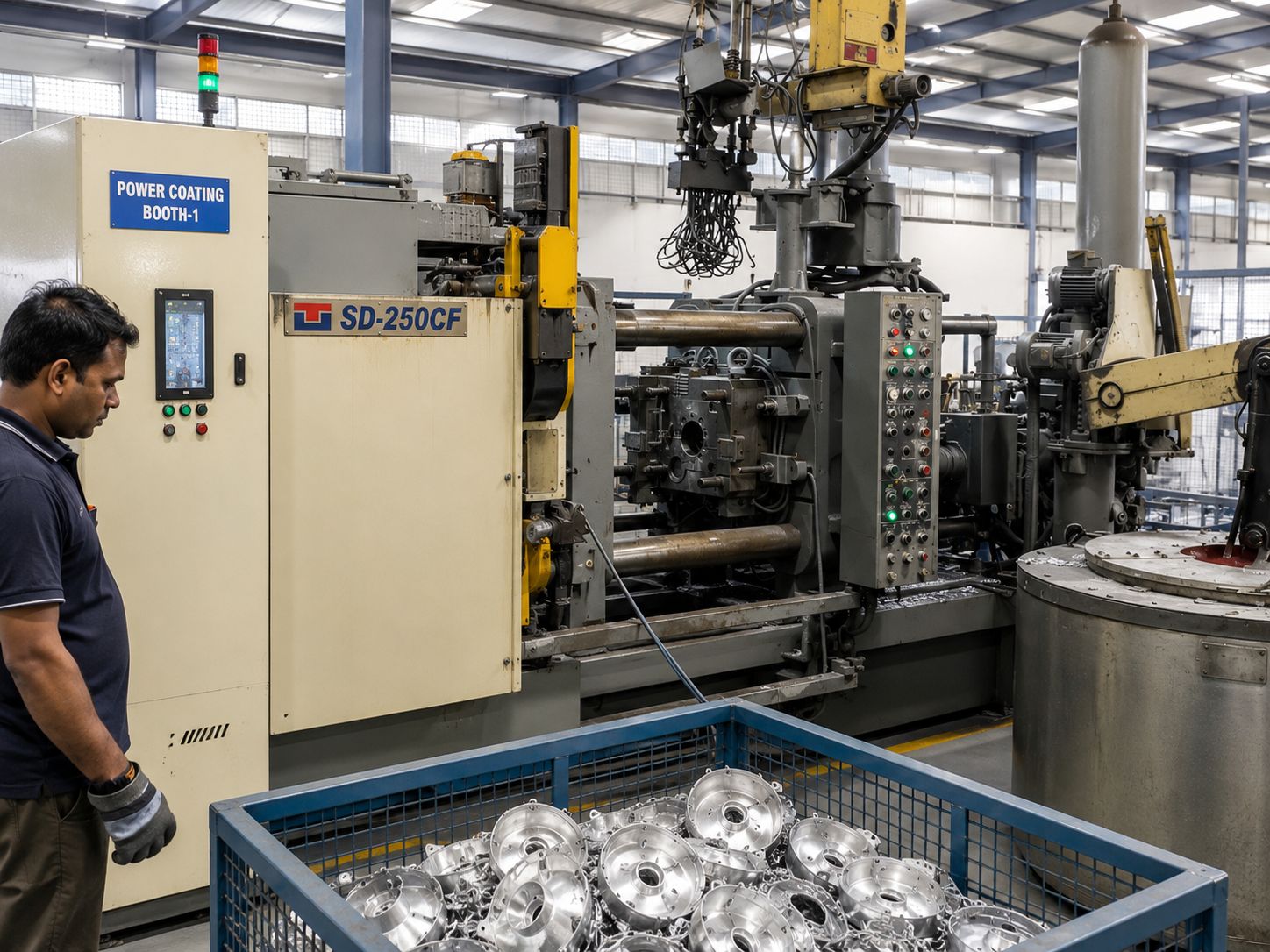
High Pressure Die Casting (HPDC) is the core of SAPL's manufacturing capability. Molten aluminium alloy is injected into a hardened steel die at metal pressures of roughly 140 to 700 bar (about 2,000 to 10,000 psi), filling the cavity in a fraction of a second. The result is a near-net-shape component with excellent surface finish and tight dimensional consistency — directly from the die.
Our HPDC capability spans 150T to 700T of clamping force: four fully-automatic machines from 150T to 350T, covering component weights from 0.150 kg to 1.5 kg, and 700-tonne capacity for larger components. All machines run automated shot monitoring that logs pressure, speed, and temperature in real time — providing process traceability for every cycle. Shot data is retained per batch and available on customer request. The 700-tonne machine (Yizumi DM700HII-S cold-chamber, 6,500 kN locking force) is rated for a projected casting area of up to 1,625 cm² at 40 MPa metal pressure. It is available for new projects and in production from late January 2027, so projects quoted now are planned around it.
HPDC is suited to medium-to-high production volumes where consistent geometry, good surface finish, and competitive per-unit cost are priorities. For components requiring exceptional structural integrity at lower volumes, our Gravity Die Casting capability offers an alternative.
Alloys
Process
How it works
Die Preparation
Die lubrication and temperature conditioning to 180–220°C. Consistent die temperature is critical for dimensional repeatability and surface quality.
Alloy Preparation
Aluminium alloy is melted and held at 640–680°C. Each melt batch is verified by OES spectrometry before casting begins.
High-Pressure Injection
Molten metal is injected at metal pressures of roughly 140–700 bar. The cavity fills in milliseconds, producing dense, near-net-shape components with excellent surface finish.
Rapid Solidification
Water-cooled die channels extract heat rapidly. Controlled cooling rates reduce porosity and improve dimensional stability.
Ejection & Trimming
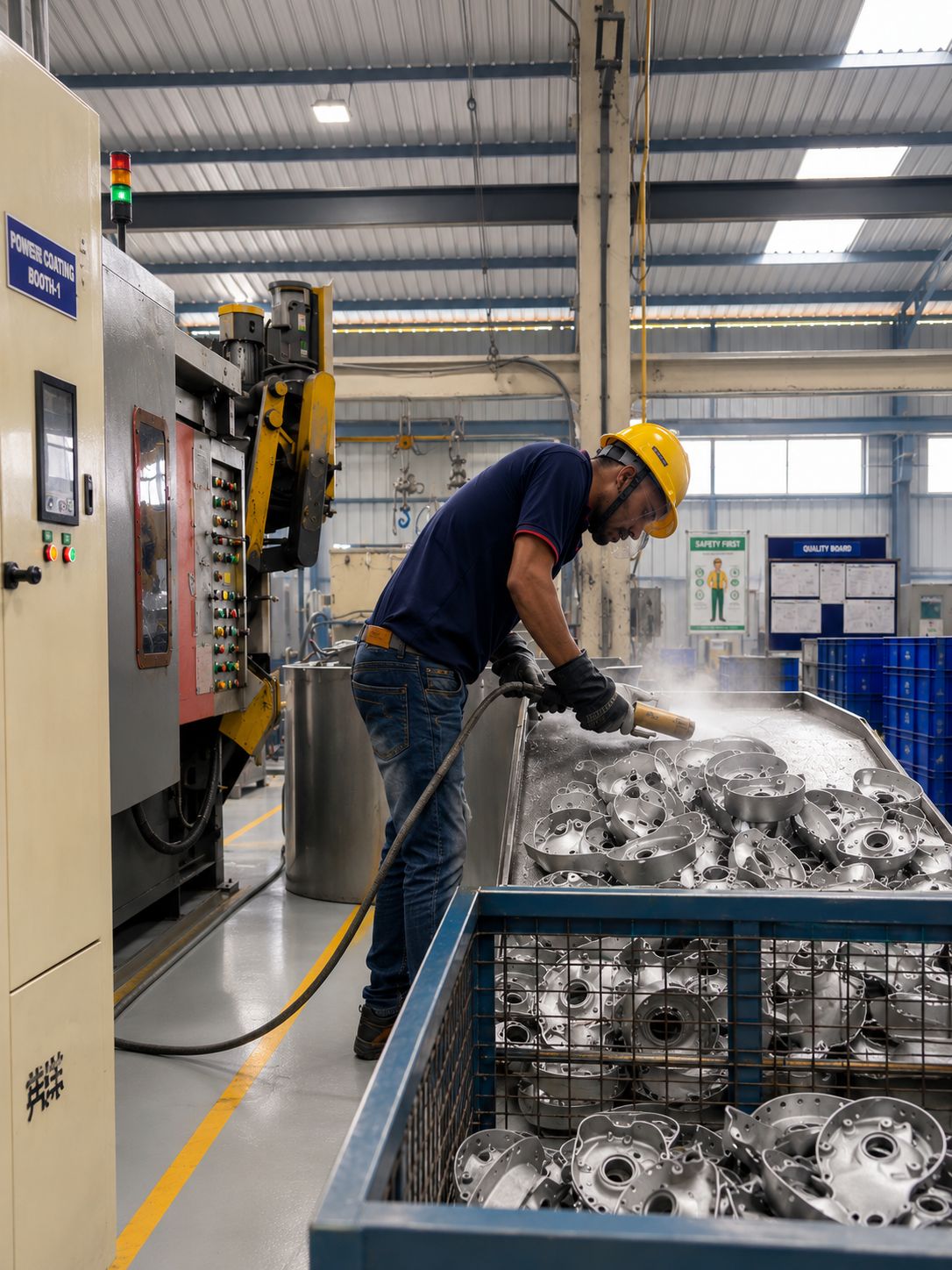
Component is ejected and transferred to trimming. Flash, gates, and runners are removed. Critical surfaces are inspected for casting defects.
Inspection & Release
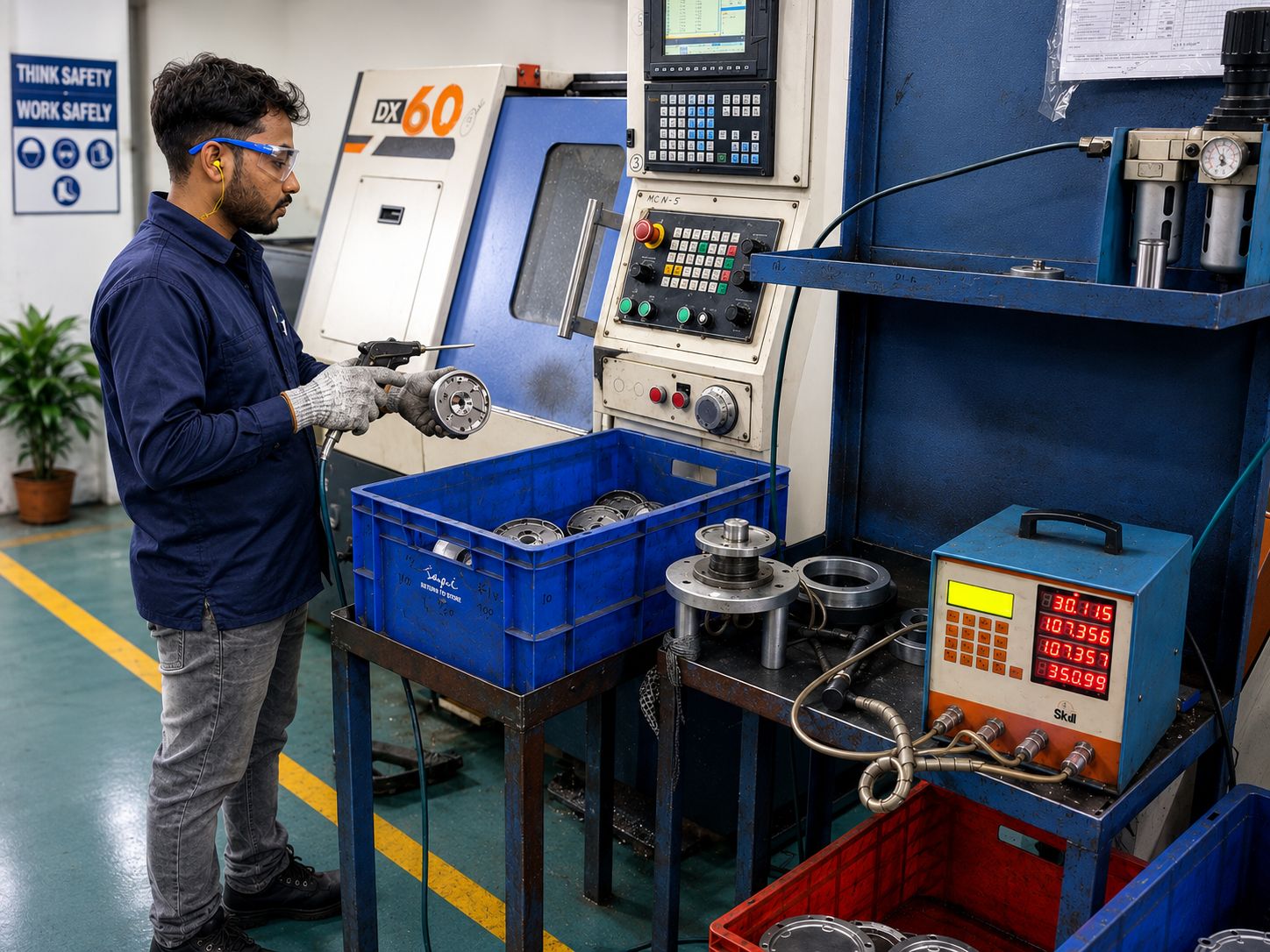
First-off inspection against customer drawing. In-process checks per agreed control plan. CMM verification on GD&T-critical features before batch release.
Applications
Industries and use cases
Components produced via HPDC are supplied to OEMs and Tier-1 manufacturers across these sectors.
HVAC & Air Movement
Fan housings, motor covers, blower casings, impeller bodies, keyway hubs
Consumer Appliances
Ceiling fan top/bottom covers, motor bodies, mixer grinder housings, pump covers
Automotive
Mechanical pump housings, bracket assemblies, engine accessory housings
Pumps & Valves
Pump impeller housings, valve bodies, manifold blocks
Electrical
Motor housings, enclosure bodies, solenoid housings, junction boxes
Agriculture & Off-Highway
Tractor covers, hydraulic component housings, implement castings
Locations We Serve
Die casting company in Chakan, Pune —
supplying OEMs across India
Our facility is located at MIDC Chakan, Pune — India’s largest automotive and industrial manufacturing hub. We supply OEMs and Tier-1 manufacturers across India, with export supply to Europe.
Our Manufacturing Facility
Chakan MIDC, Pune — Maharashtra
Chakan Industrial Area, MIDC Chakan
Pune, Maharashtra 410501
India
Strategically located in Pune’s industrial corridor — 30 km from Pune city, 100 km from Mumbai. Within the MIDC Chakan zone alongside Volkswagen, Mercedes-Benz, Bajaj, and 1,000+ tier suppliers.
4
HPDC Machines
150–700T
Tonnage Range
250,000+
Castings / Month
ISO 9001
2015 Certified
OEM customers across India
Pune
Primary hub
Chakan
MIDC — facility
Mumbai
Maharashtra
Chennai
Tamil Nadu
Rajkot
Gujarat
Ahmedabad
Gujarat
Coimbatore
Tamil Nadu
Delhi NCR
North India
Bengaluru
Karnataka
Hyderabad
Telangana
Aurangabad
Maharashtra
Nashik
Maharashtra
We supply die casting components pan-India. If your facility is not listed, contact us — we work with OEMs anywhere in India and export to Europe (Poland, Italy, and beyond).
Related
Connected capabilities
Gravity Die Casting
LM25 aluminium alloy cast in permanent steel dies using gravity fill.
View capability →CNC & VMC Machining
Over 20 CNC turning centres and Vertical Machining Centres — including 4th-axis VMC for complex geometries.
View capability →Contract Manufacturing
From raw casting to finished, inspected, and packed component — under one roof, one management team, one Certificate of Conformance.
View capability →Get Started
Discuss your HPDC component with our engineering team
Share your drawings — STEP, IGES, DXF, PDF, or SolidWorks. We'll review manufacturability, confirm the right alloy, and respond with a detailed technical and commercial assessment within 72 hours.