
Product · HVAC & Air Movement
Fan Blade
Hub.
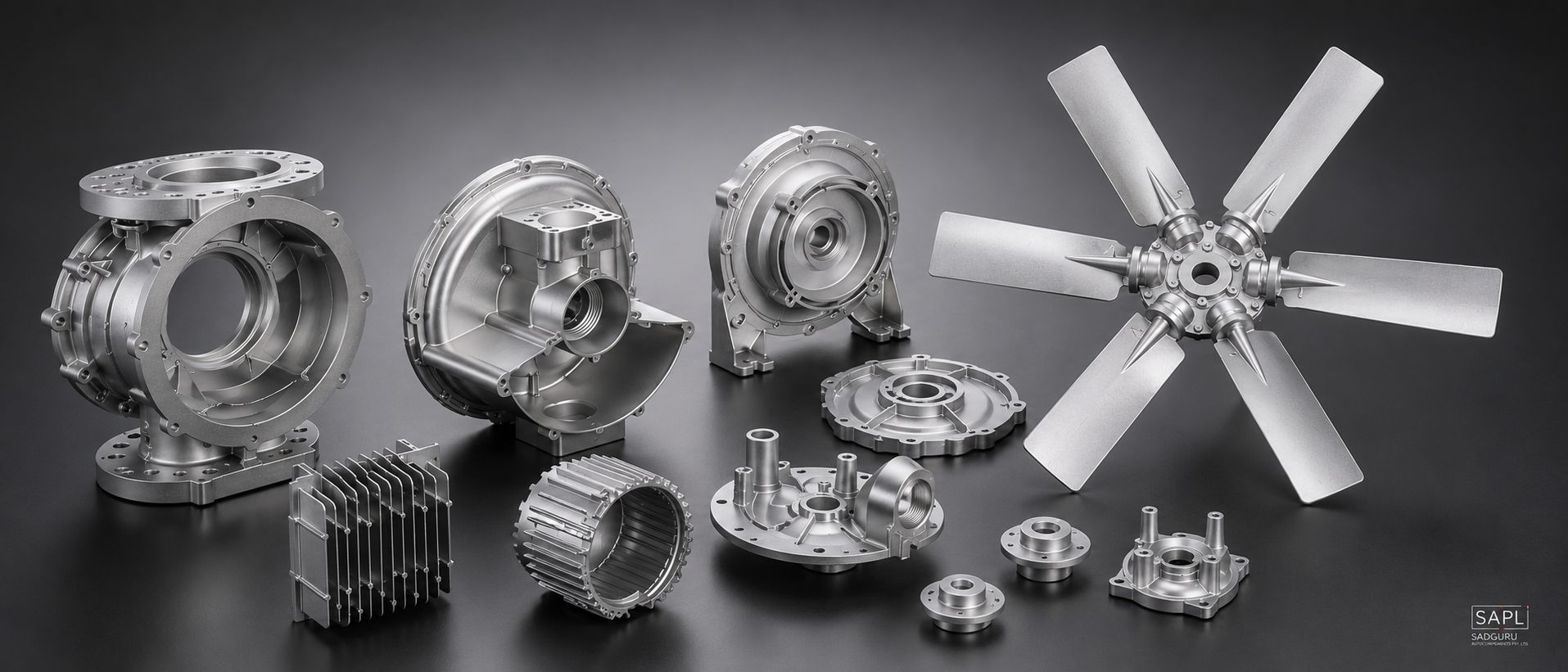
Die cast aluminium fan blade hubs for HVAC and industrial air movement equipment — precision central bore, consistent blade arm pitch circle, and balanced mass distribution for vibration-free operation at rated speed.
Product Overview
Fan Blade Hub
Fan blade hubs are precision components that transfer torque from the motor shaft to the blade assembly. In HVAC and air movement applications, they operate continuously at fixed speeds — making dimensional precision, balance, and bore fit directly connected to equipment noise and longevity. SAPL produces fan blade hubs by HPDC for high-volume programmes and GDC for larger, heavier configurations.
The central bore is machined to H7 tolerance with a keyway milled to DIN 6885 dimensions. Blade arm mounting bosses are positioned on a common pitch circle diameter (PCD) to within ±0.2 mm true position, ensuring equal blade pitch. Static balance is checked on all hubs, with dynamic balance testing available on request for high-speed applications.
SAPL supplies fan blade hubs to HVAC OEMs as a finished machined component. Where mounting screws or blade pins are customer-specified, boss holes are drilled and tapped in the machining sequence. Hubs are supplied with a light protective film or as-machined depending on the customer requirement.
Quality
Critical quality requirements
These are the characteristics SAPL controls and measures on every production batch for this component — and how they are maintained in the process.
Bore and keyway geometry
The bore–keyway combination is the primary torque transmission interface. Bore must be H7, keyway width to JS9, and the keyway must be symmetric with the bore centreline to within 0.05 mm. SAPL machines bore and keyway in sequence on the same CNC setup.
Blade boss PCD consistency
Unequal blade pitch causes aerodynamic imbalance and noise. Boss PCD true position is maintained to ±0.2 mm by referencing all boss locations from the bore centreline in the CNC program.
Balance
Static imbalance causes vibration at motor bearing frequency. All hubs are statically balanced post-machining, with correction by material removal on a balance-correction boss cast into the hub for this purpose.
FAQ
Common questions
Questions from procurement teams and design engineers about this component.
Ask a technical question →Can SAPL produce fan blade hubs by both HPDC and GDC?
Yes. HPDC is used for lighter hubs (up to approximately 350 g) where cycle time and volume favour pressure die casting. GDC is used for heavier configurations where wall thickness and soundness requirements are better served by gravity casting. Both processes are available at SAPL's Chakan facility.
How does SAPL ensure blade balance after machining?
All hubs are statically balanced on a two-plane balance arbour after CNC machining. Correction is made by drilling into a dedicated balance correction boss cast into the hub — this avoids material removal from functional surfaces. Dynamic balancing is available for high-speed applications on request.
What keyway dimensions can SAPL machine?
SAPL machines parallel keyways to DIN 6885 as standard. Alternative keyway profiles — Woodruff, spline, or customer-specific — can be discussed as part of the DFM review at the RFQ stage.
Capabilities
Processes used for this component
High Pressure Die Casting
Five fully-automatic HPDC machines from 180T to 450T.
View capability →Gravity Die Casting
LM25 aluminium alloy cast in permanent steel dies using gravity fill.
View capability →CNC & VMC Machining
Over 20 CNC turning centres and Vertical Machining Centres — including 4th-axis VMC for complex geometries.
View capability →Related Products
Other components in this programme
Keyway Hub
Precision aluminium keyway hubs for motor shaft connections in HVAC, pump, and industrial drive applications — accurate bore-to-keyway geometry and consistent fit across production batches.
Retainer Block
Die cast aluminium retainer blocks for HVAC and fan assemblies — fastening and locating components with precise slot and hole geometry, supplied machined and ready for assembly.
Get Started
Sourcing fan blade hub?
Share your drawings — STEP, IGES, DXF, or PDF. SAPL will review manufacturability, confirm alloy and process, and respond with a technical and commercial proposal within 72 hours.