
Product · HVAC & Air Movement
Keyway
Hub.
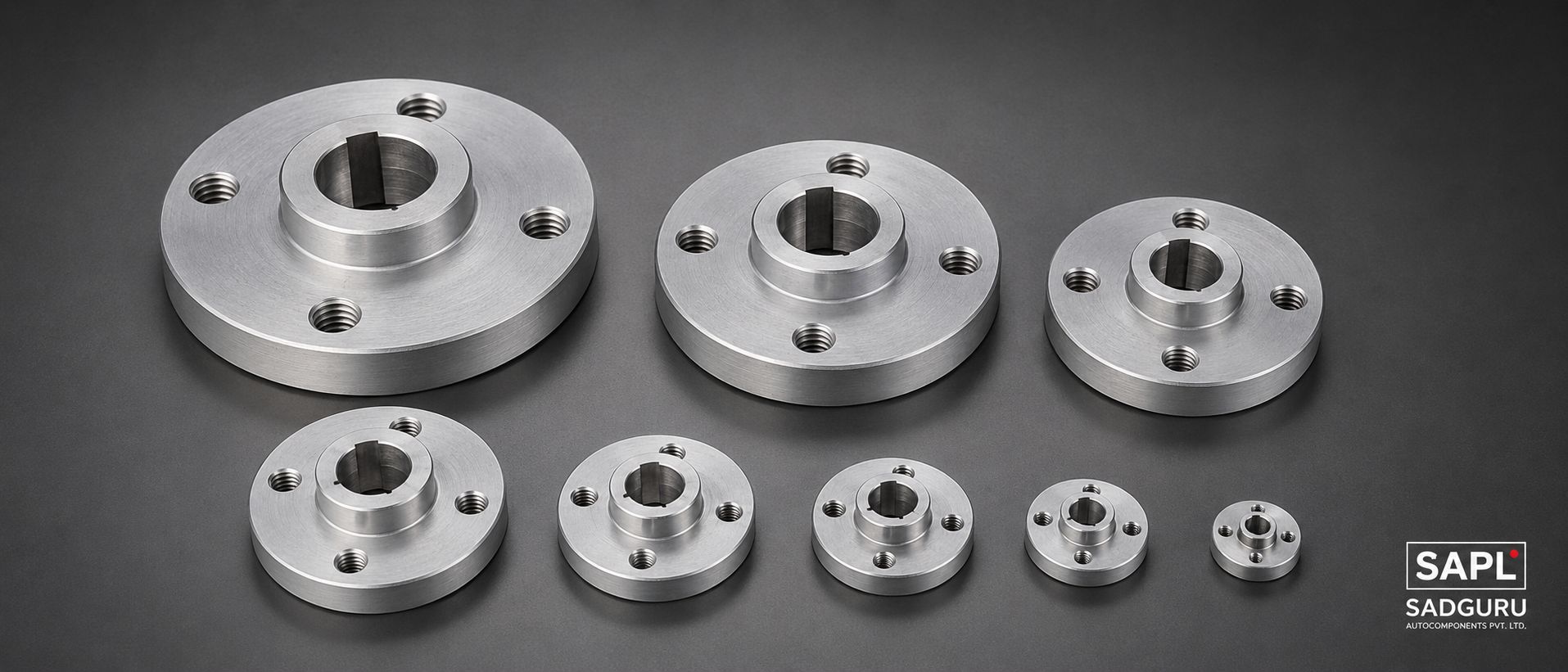
Precision aluminium keyway hubs for motor shaft connections in HVAC, pump, and industrial drive applications — accurate bore-to-keyway geometry and consistent fit across production batches.
Product Overview
Keyway Hub
Keyway hubs transmit torque from motor shafts to fan blades, pulleys, or other driven components. The critical geometry is the bore-to-keyway relationship: the bore must be sized and finished to H7 to achieve the correct interference or clearance fit with the shaft, while the keyway must be accurately positioned relative to the bore centreline and dimensioned to DIN 6885 (or customer equivalent) to ensure consistent key fit.
SAPL produces keyway hubs by HPDC and GDC depending on the configuration. The cast blank is then machined on a VMC to final bore size and keyway form. Bore sizes from 12 mm to 60 mm are currently in production; larger bores can be discussed at the DFM review stage. All keyways are milled — not broached — to allow in-house flexibility without dedicated broach tooling.
Where keyway hubs are used in high-cycle applications (continuous duty HVAC fans, pumps), SAPL applies heat treatment or surface hardening on request to improve wear resistance at the key contact faces.
Quality
Critical quality requirements
These are the characteristics SAPL controls and measures on every production batch for this component — and how they are maintained in the process.
Bore sizing accuracy
Bore must be machined to H7 tolerance to achieve the design interference or clearance fit with the motor shaft. SAPL uses precision boring on the VMC with in-process air gauging to maintain bore size within ±0.005 mm of target.
Keyway position
The keyway centreline must be symmetric with the bore centreline to within 0.05 mm. SAPL programs keyway milling referenced from the bore datum in the same setup to eliminate fixturing errors.
Key face surface finish
Poor surface finish on keyway flanks increases stress concentration and reduces fatigue life of the key. Keyway flanks are milled with a carbide end mill to Ra ≤ 3.2 µm without secondary operations.
FAQ
Common questions
Questions from procurement teams and design engineers about this component.
Ask a technical question →Does SAPL mill or broach the keyway?
SAPL mills all keyways using carbide end mills on the VMC. Milling is flexible — it accommodates the full range of DIN 6885 key sizes without dedicated broach tooling, and allows keyway profiles outside the DIN standard where customer drawings require it.
What is the tightest bore tolerance SAPL can hold on keyway hubs?
H7 is the standard production tolerance. Tighter tolerances (H6, or specific bilateral tolerances) are achievable on a case-by-case basis and should be discussed at the RFQ stage so SAPL can confirm process capability and, where required, perform a Cpk study on first-article samples.
Can SAPL supply keyway hubs with a set-screw?
Boss holes for set-screws are drilled and tapped as part of the standard machining sequence. The set-screw itself is not typically supplied, but SAPL can include it as a purchased item at customer request.
Capabilities
Processes used for this component
High Pressure Die Casting
Five fully-automatic HPDC machines from 180T to 450T.
View capability →Gravity Die Casting
LM25 aluminium alloy cast in permanent steel dies using gravity fill.
View capability →CNC & VMC Machining
Over 20 CNC turning centres and Vertical Machining Centres — including 4th-axis VMC for complex geometries.
View capability →Related Products
Other components in this programme
Fan Blade Hub
Die cast aluminium fan blade hubs for HVAC and industrial air movement equipment — precision central bore, consistent blade arm pitch circle, and balanced mass distribution for vibration-free operation at rated speed.
Tractor Pulley
Gravity die cast aluminium pulleys for tractor and off-highway drive systems — precision groove profile, CNC machined bore and keyway, and balanced mass distribution for belt-driven auxiliary drives.
Get Started
Sourcing keyway hub?
Share your drawings — STEP, IGES, DXF, or PDF. SAPL will review manufacturability, confirm alloy and process, and respond with a technical and commercial proposal within 72 hours.