
Product · Medical
Surgical Bone
Cutter Handle.
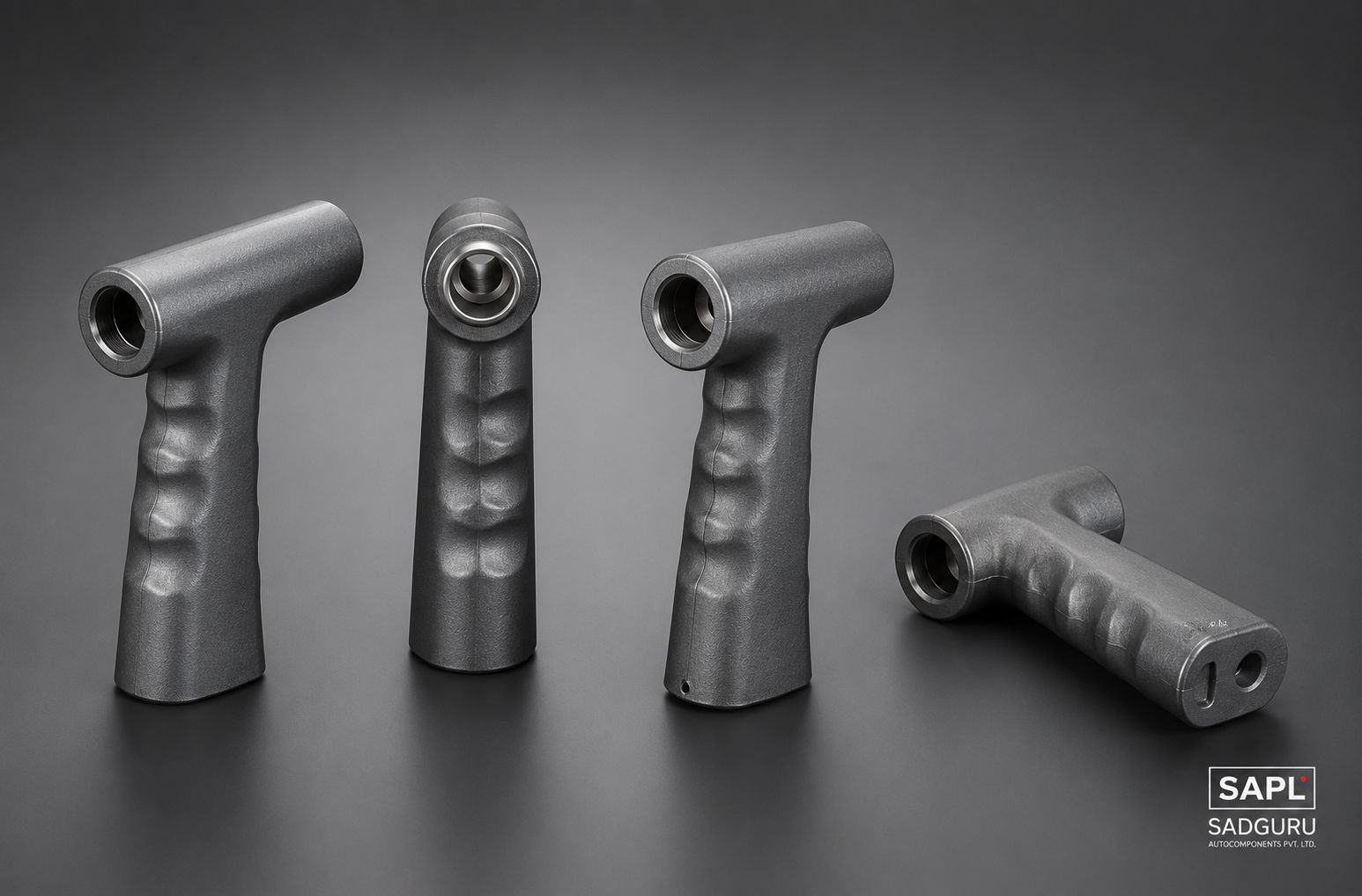
Precision aluminium handles for surgical bone cutting instruments — ergonomic geometry, smooth machined grip surfaces, and material selection suited for sterilisation and repeated surgical use.
Product Overview
Surgical Bone Cutter Handle
Surgical instrument handles present some of the most demanding surface finish and dimensional accuracy requirements in die casting. The LM25 aluminium alloy is selected for its combination of strength, machinability, anodising response, and biocompatibility — properties that ADC12 and LM24 do not provide to the same level. SAPL produces bone cutter handles by gravity die casting, which provides the internal soundness and surface quality required before finish machining.
Post-cast CNC machining covers the grip profile, instrument connection bore, and all mating features with surgical cutting elements. Grip surfaces are machined to Ra ≤ 0.8 µm to facilitate complete sterilisation in autoclave cycles without trapping biological material in surface roughness. The finished handle is hard anodised to produce a dense Al2O3 layer that provides hardness, corrosion resistance, and an electrically insulating surface.
SAPL manages this product under a dedicated quality plan with full material traceability (heat number to finished handle), dimensional inspection of all mating features, and surface finish measurement. First-article samples are provided with a full inspection report and material certificate.
Quality
Critical quality requirements
These are the characteristics SAPL controls and measures on every production batch for this component — and how they are maintained in the process.
Surface finish for sterilisation
Surgical instruments require surface finish Ra ≤ 0.8 µm on all grip and contact surfaces to ensure complete sterilisation without bacterial harbouring in surface defects. SAPL achieves this with fine CNC turning and milling, and verifies finish with a contact profilometer on first-article and periodic production samples.
Hard anodise thickness and hardness
The hard anodise layer must be 20–40 µm thick and achieve ≥ 350 HV to provide adequate scratch resistance and electrical insulation for surgical use. Anodise thickness is measured by eddy current gauge on finished parts, and hardness is verified by Vickers indentation on test coupons processed in the same batch.
Dimensional accuracy at instrument connection
The connection interface between the handle and cutting element must be dimensionally accurate to prevent play or misalignment during use. Connection bores and mating features are machined to H7 or closer tolerance as specified, and verified with calibrated gauging on 100% of parts.
FAQ
Common questions
Questions from procurement teams and design engineers about this component.
Ask a technical question →Why is LM25 used for surgical instrument handles rather than ADC12?
LM25 (Al-Si7Mg) has a cleaner alloy composition with lower iron and copper content than ADC12 or LM24. This gives better anodising response (producing a denser, more uniform Al2O3 layer), better machinability to fine surface finishes, and improved corrosion resistance — all important properties for repeated surgical sterilisation cycles.
Is the hard anodise coating compatible with autoclave sterilisation?
Yes. Hard anodise (Type III anodising) is well-established for surgical instrument applications. The Al2O3 layer is chemically inert, thermally stable to above 1000°C, and unaffected by the 134°C steam environment of a standard autoclave sterilisation cycle. SAPL verifies autoclave compatibility on first-article samples.
Can SAPL provide full traceability documentation for medical components?
Yes. SAPL maintains heat number traceability for all LM25 alloy deliveries and can provide a material certificate, first-article dimensional inspection report, and surface finish measurement record with each new programme. In production, lot traceability is maintained and a certificate of conformance is provided with each delivery.
Capabilities
Processes used for this component
Gravity Die Casting
LM25 aluminium alloy cast in permanent steel dies using gravity fill.
View capability →CNC & VMC Machining
Over 20 CNC turning centres and Vertical Machining Centres — including 4th-axis VMC for complex geometries.
View capability →Engineering Support
DFM analysis, alloy selection guidance, design review, and prototype samples — before drawings are frozen and tooling is cut.
View capability →Related Products
Other components in this programme
Mechanical Pump Housing
High-pressure die cast aluminium pump housings for automotive and industrial mechanical pumps — pressure-tight casting integrity, precision machined fluid ports, seal grooves, and mating flange faces.
Solenoid Housing
High-pressure die cast aluminium solenoid valve housings — precision bore for solenoid body, machined port threads, pressure-tight wall sections, and consistent dimensions across high-volume production for industrial fluid control applications.
Get Started
Sourcing surgical bone cutter handle?
Share your drawings — STEP, IGES, DXF, or PDF. SAPL will review manufacturability, confirm alloy and process, and respond with a technical and commercial proposal within 72 hours.