
Product · Agriculture & Off-Highway
Tractor
Pulley.
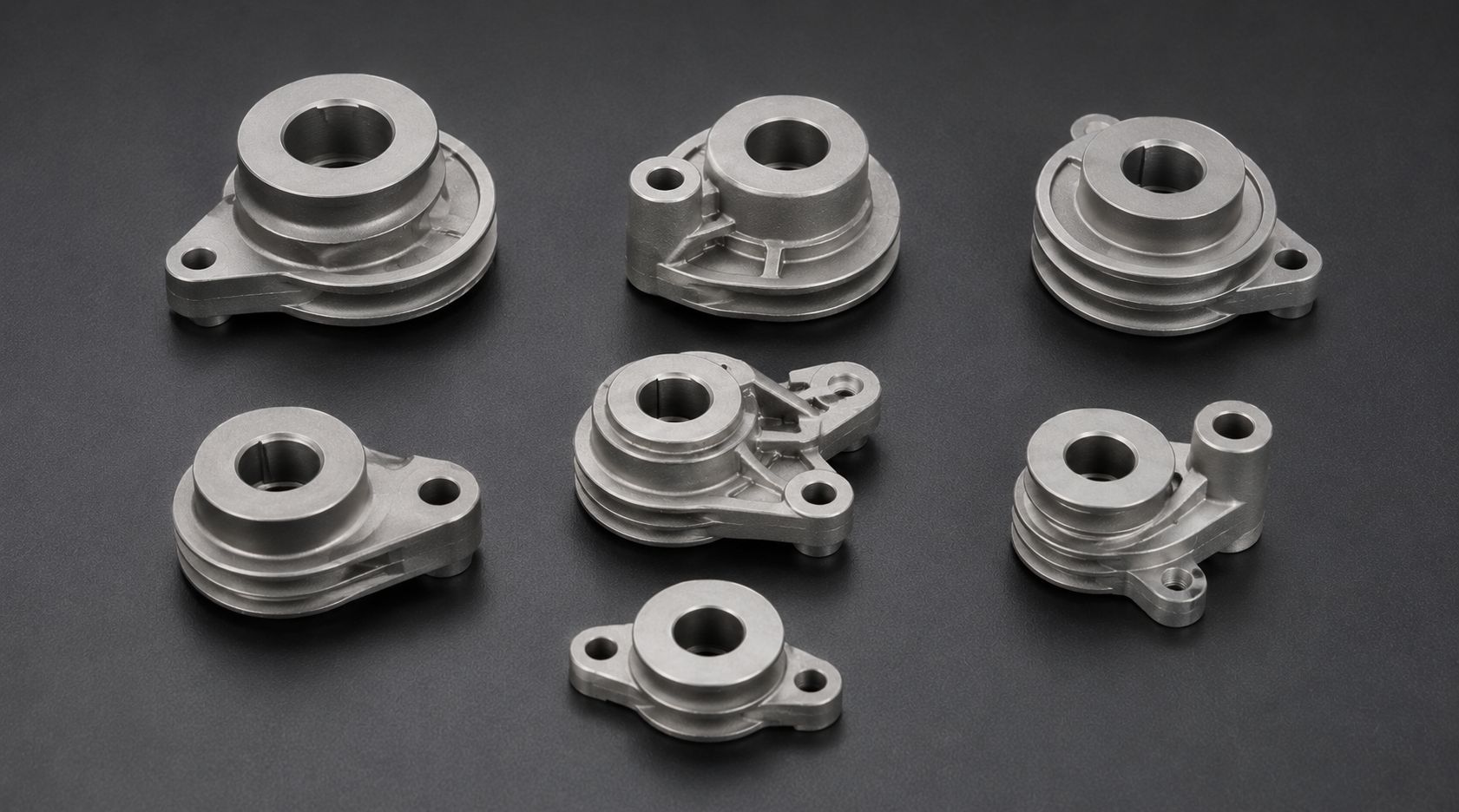
Gravity die cast aluminium pulleys for tractor and off-highway drive systems — precision groove profile, CNC machined bore and keyway, and balanced mass distribution for belt-driven auxiliary drives.
Product Overview
Tractor Pulley
Tractor pulleys transmit power to belt-driven auxiliary systems — alternators, water pumps, cooling fans, hydraulic pumps, and PTO accessories. The groove profile must match the belt standard precisely; any deviation causes uneven belt load distribution, accelerated belt wear, and ultimately belt failure. SAPL produces tractor pulleys by gravity die casting in LM24 alloy, which provides the combination of strength and machinability required.
Post-cast machining covers the bore (H7), keyway (DIN 6885), and groove profile. Groove form is machined on a CNC lathe with a profile-ground insert to achieve the correct flank angle, groove depth, and root radius. Where multiple grooves are specified, groove spacing is controlled to within ±0.1 mm to ensure even multi-belt loading.
All pulleys are statically balanced after machining. The GDC blank is cast with a balance correction boss that allows material removal without affecting functional surfaces. Dynamic balancing is available for high-speed auxiliary drive applications where vibration is a concern.
Quality
Critical quality requirements
These are the characteristics SAPL controls and measures on every production batch for this component — and how they are maintained in the process.
Groove profile accuracy
Belt groove flank angle and depth are critical. Incorrect flank angle causes the belt to ride too high or too low in the groove, changing the effective pitch diameter and belt tension. SAPL machines grooves with a profiled insert and measures groove form with a profile projector or CMM on first-article and periodic samples.
Bore and keyway concentricity
The bore centreline must coincide with the groove centreline to within 0.1 mm TIR to prevent belt oscillation at pulley speed. Bore and groove are machined in the same CNC setup, referenced from the casting datum, to maintain alignment.
Static balance
Mass imbalance in a pulley creates a rotating centrifugal force at the belt frequency that excites bearing vibration. All pulleys are balanced to G6.3 after machining; material removal is made on the balance correction boss.
FAQ
Common questions
Questions from procurement teams and design engineers about this component.
Ask a technical question →Why is LM24 used for tractor pulleys rather than ADC12?
LM24 has higher silicon content and better machinability characteristics than ADC12, making it preferred for components where extensive CNC turning and groove profiling are required. Its tensile strength and dimensional stability under temperature also make it appropriate for drive system components.
What belt standards can SAPL machine groove profiles for?
SAPL can machine groove profiles to ISO 4183 (classical V-belt), ISO 22: (narrow V-belt), poly-V (ribbed belt), and flat belt profiles. For non-standard profiles, a customer drawing with full groove geometry is required, and SAPL will confirm machinability at the DFM review.
Can SAPL supply multi-groove pulleys?
Yes. Multi-groove pulleys (2, 3, or 4 grooves) are within SAPL's capability. Groove spacing is machined and controlled to ±0.1 mm between groove centrelines to ensure even load distribution across belts.
Related Products
Other components in this programme
Tractor Cover
Gravity and high-pressure die cast aluminium tractor covers for agricultural and off-highway vehicles — robust wall sections, dimensional stability across temperature cycles, and durable surface treatment for outdoor environments.
Keyway Hub
Precision aluminium keyway hubs for motor shaft connections in HVAC, pump, and industrial drive applications — accurate bore-to-keyway geometry and consistent fit across production batches.
Get Started
Sourcing tractor pulley?
Share your drawings — STEP, IGES, DXF, or PDF. SAPL will review manufacturability, confirm alloy and process, and respond with a technical and commercial proposal within 72 hours.