
Product · Consumer Appliances
Mixer Grinder
Motor Body.
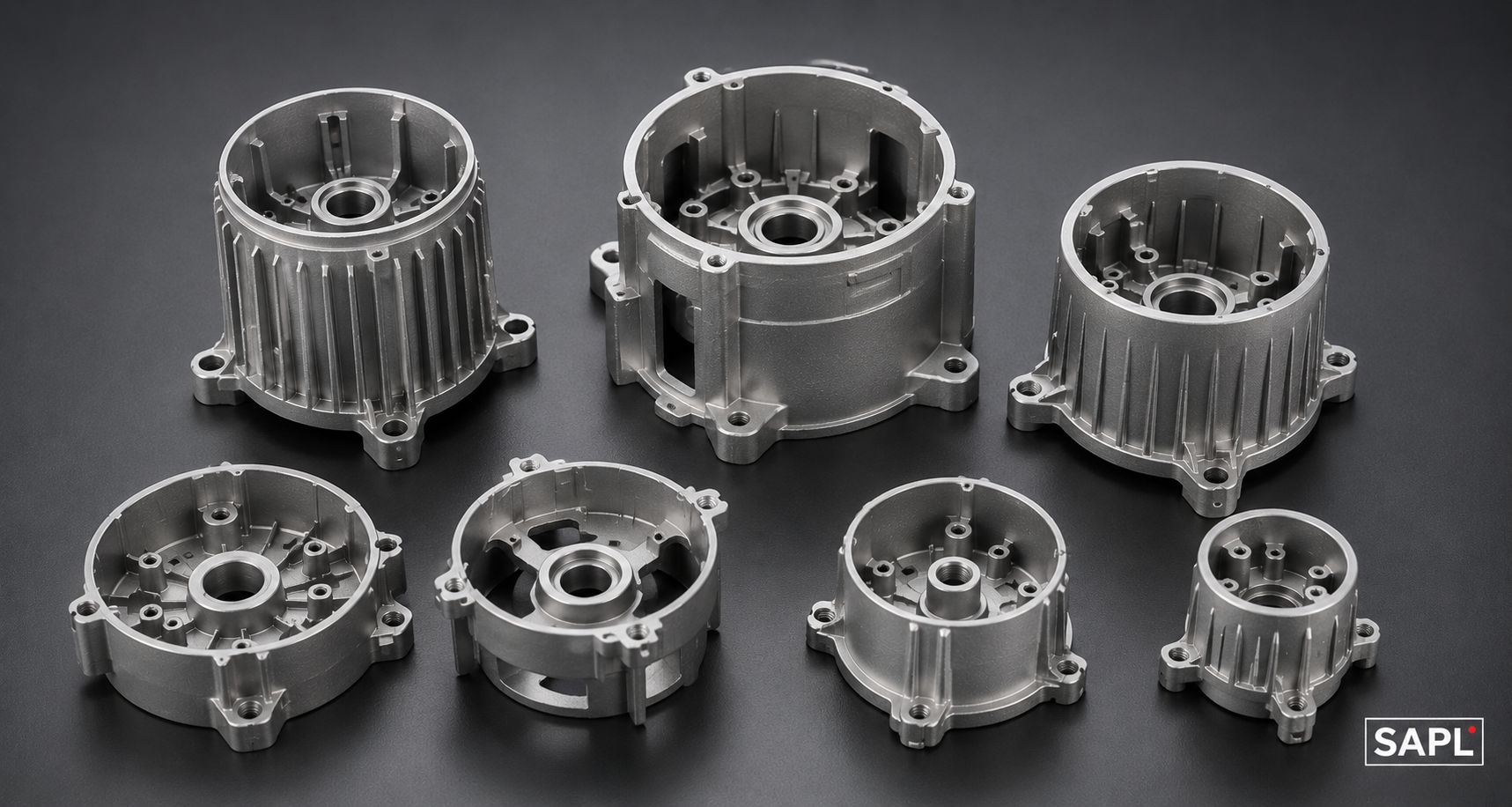
Die cast aluminium motor bodies for mixer grinders — complex multi-port geometry, precision bearing seat and stator fit, integral ventilation channels, produced at high volume with consistent dimensional quality.
Product Overview
Mixer Grinder Motor Body
The mixer grinder motor body is a compact, high-complexity casting. It must simultaneously locate the stator, provide bearing seats at both shaft ends, accommodate ventilation air flow through integral channels, and present mounting features for the appliance housing. SAPL produces these bodies on 250T HPDC machines where the short cycle time is matched to the high monthly volumes required by appliance OEMs.
Integral ventilation channel geometry is cast in — no secondary drilling or milling is required for the airflow passages. All precision bores — stator fit, upper bearing seat, lower bearing seat — are machined in a single CNC setup to maintain concentricity. The external mounting pads are milled flat to ±0.1 mm in the same setup.
SAPL holds specific process approvals for multiple mixer grinder motor body programmes across Pune-based appliance OEMs. The production quality plan includes 100% in-line gauging of bore diameters and a periodic SPC review of key dimensions.
Quality
Critical quality requirements
These are the characteristics SAPL controls and measures on every production batch for this component — and how they are maintained in the process.
Concentricity of bearing seats
Upper and lower bearing seats must be concentric to within 0.05 mm TIR. SAPL machines both seats in a single VMC setup referenced from the stator bore datum to ensure alignment.
Porosity at bearing surfaces
Porosity at bearing locations causes noise and reduced bearing life — critical quality requirements for consumer appliance OEMs. SAPL uses X-ray sampling and cross-section inspection on a statistical basis to monitor internal soundness.
Wall thickness at ventilation channels
Thin walls between ventilation channels can collapse under die casting pressure. SAPL validates minimum wall thickness at die approval stage and monitors via CMM on first-off and periodic samples.
FAQ
Common questions
Questions from procurement teams and design engineers about this component.
Ask a technical question →Can SAPL manage the full sequence for mixer grinder motor bodies?
Yes. SAPL handles HPDC casting, trimming and deburring, VMC machining of all precision bores and mounting faces, and quality inspection including 100% gauging of bore diameters. The component is delivered ready for motor winding assembly.
What monthly volumes can SAPL support for this component?
Current capacity supports 30,000+ pieces per month for a given configuration. Mixer grinder programmes are typically high-volume and SAPL allocates dedicated machine time and tooling for approved production programmes.
Does the motor body require surface coating?
External surfaces are typically left as-cast or given a light deburr and cleaning — most mixer grinder motor bodies are hidden inside the plastic housing. If the programme requires corrosion protection, SAPL can apply an anodic or conversion coating on request.
Related Products
Other components in this programme
Fan Motor Housing
High-pressure die cast aluminium motor housings for ceiling and exhaust fans — precision bearing seat bores, stator fit diameter, and integral ventilation geometry produced in one casting with post-cast CNC machining.
Ceiling Fan Top Cover
High-pressure die cast aluminium top covers for ceiling fans — precision blade-arm bosses, clean visible surfaces, and consistent dimensional accuracy across high-volume production runs.
Get Started
Sourcing mixer grinder motor body?
Share your drawings — STEP, IGES, DXF, or PDF. SAPL will review manufacturability, confirm alloy and process, and respond with a technical and commercial proposal within 72 hours.