
Published 23 July 2026 · 9 min read · Industry Insight
The Demands on a Poultry Gearbox Housing
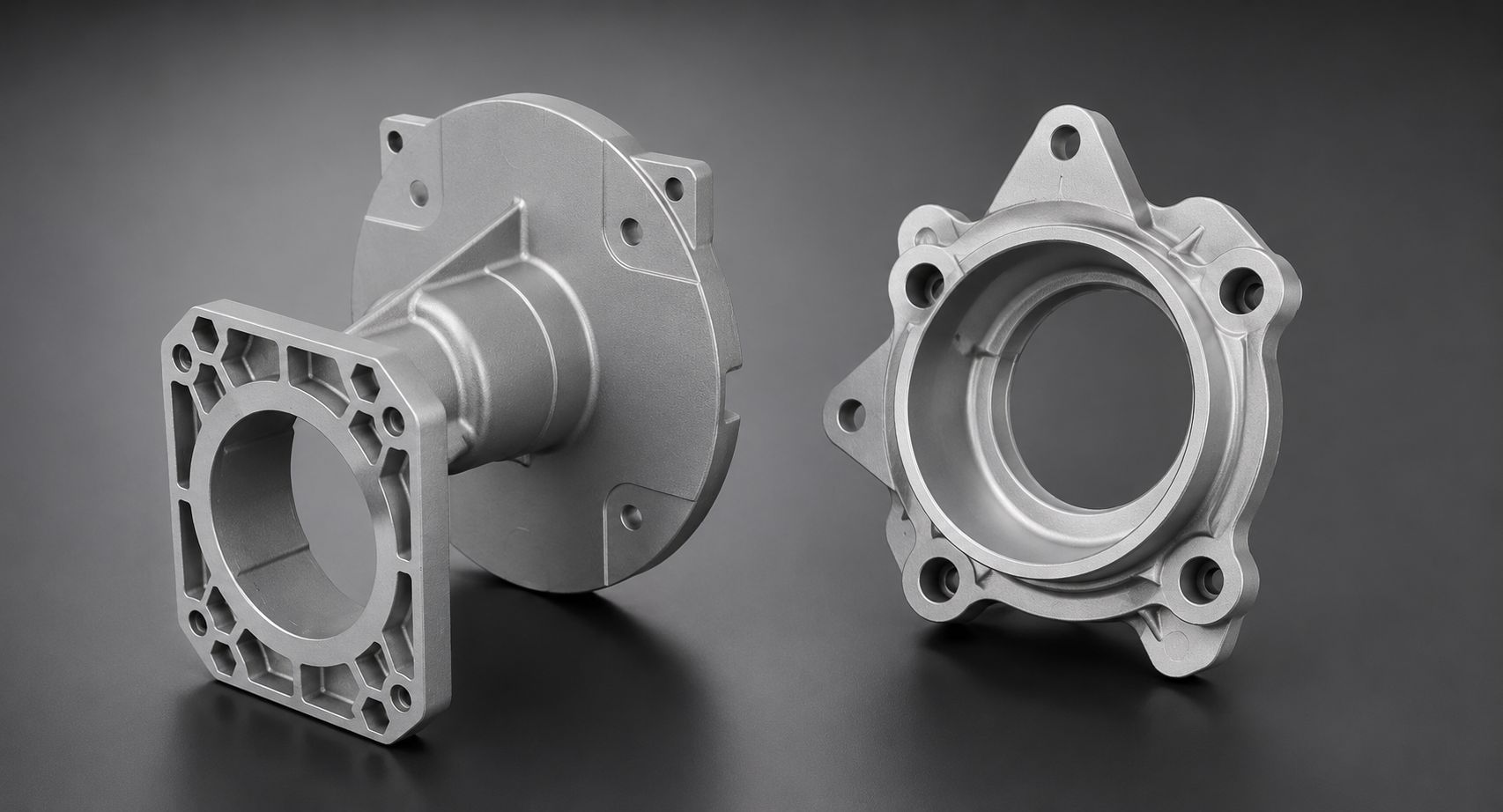
Gearbox housings used in poultry farming equipment — ventilation fans, feed conveyor drives, egg collection systems, and climate control units — operate in some of the most aggressive light-industrial environments a mechanical component can encounter. Airborne ammonia from litter breakdown attacks unprotected metal surfaces. Wash-down cycles with pressurised water and disinfectant chemicals are routine. Temperatures fluctuate between unheated winter conditions and humid summer heat loads.
At the same time, the dimensional requirements are unforgiving. Bearing bores must be held to H7 tolerance to prevent premature bearing failure. Gear cavity geometry must be accurate to maintain correct mesh. Mounting faces must be flat and square to prevent misalignment under load. And because poultry equipment is manufactured in high volumes — hundreds or thousands of units per batch — the casting process must deliver that consistency part after part, not just on the first article.
Cast iron was the default material for gearbox housings for decades. It handles the structural and damping requirements well. But at roughly 7.1 g/cm³, it is nearly three times heavier than aluminium. For equipment that is mounted overhead, moved frequently, or where weight reduction has a downstream energy cost, that difference is significant. Corrosion resistance is another weakness: uncoated cast iron rusts quickly in wet agricultural environments, requiring additional surface treatment that adds cost and process steps.
Aluminium die casting, specifically High Pressure Die Casting (HPDC) using ADC12 alloy, addresses both problems and adds further advantages that make it the preferred process for high-volume poultry gearbox housing production.
Why ADC12 HPDC Suits This Application
ADC12 (equivalent to A383 in the ASTM system) is the most widely used aluminium alloy in HPDC for industrial applications. Its composition — roughly 9.6–12% silicon, with copper and small additions of iron, manganese, and zinc — gives it a specific combination of properties that align well with gearbox housing requirements.
Castability. The elevated silicon content gives ADC12 excellent fluidity in the die, allowing it to fill complex cavity geometries including thin walls, deep pockets, and intersecting ribs. This matters for gearbox housings, which typically combine thick bearing bosses with thin web sections.
Machinability. Compared to A380, ADC12 machines more cleanly. Bearing bores, seal grooves, port threads, and mounting face surfaces are all finish-machined after casting, and ADC12 produces good surface finish at competitive tool life.
Dimensional stability. ADC12 has a low and predictable shrinkage rate in the die, which is essential for holding bearing bore location and gear cavity geometry consistently across a production run.
Corrosion resistance. Aluminium naturally forms a stable oxide layer that resists moisture and mild chemical exposure. With an additional powder coat or anodising treatment, ADC12 gearbox housings withstand agricultural wash-down environments without the rust risk of uncoated iron.
Weight. At 2.7 g/cm³, an ADC12 gearbox housing is approximately 60% lighter than an equivalent cast iron housing. For a typical poultry fan gearbox housing weighing 1.8 kg in iron, the aluminium equivalent comes in around 700 g.
Material Comparison
The table below compares ADC12 against the other alloys and processes most often considered for gearbox housings.
| Property | ADC12 HPDC | A380 HPDC | LM25 GDC | Cast Iron | Zinc (HPDC) |
|---|---|---|---|---|---|
| Density (g/cm³) | 2.74 | 2.71 | 2.68 | 7.15 | 6.6 |
| Tensile strength (MPa) | ≈ 310 | ≈ 320 | 180–230 | 200–250 | 280–330 |
| Elongation (%) | 1–2 | 2–3.5 | 5–7 | 0.5–1 | 6–10 |
| Machinability | Good | Moderate | Excellent | Moderate | Excellent |
| Corrosion resistance | Good | Good | Good | Poor (uncoated) | Good |
| Min. wall thickness (mm) | 1.5 | 1.5 | 3.0 | 4.0 | 0.8 |
| Relative unit cost at volume | Low | Low | Medium | Medium | Low–Medium |
| Suitable for bearing H7 bore | Yes (post-machine) | Yes (post-machine) | Yes (post-machine) | Yes (post-machine) | Limited |
HPDC vs Gravity Die Casting for Gearbox Housings
Both processes can produce aluminium gearbox housings. The right choice depends on volume, geometry, and structural requirements.
HPDC injects molten metal into a hardened steel die at pressures between 700 and 1,500 bar. Cycle times are short — typically 30 to 90 seconds per shot — making it cost-effective from around 500 units per year upward. Wall thickness can go as low as 1.5mm, and dimensional repeatability is excellent. The rapid solidification under pressure can introduce micro-porosity in thick sections, which is relevant if the housing will be pressure-tight or welded, but for most gearbox housing applications this is not a constraint.
Gravity Die Casting (GDC) fills the die under gravity with no applied pressure. Solidification is slower, which produces a denser microstructure with better elongation and fatigue performance. This makes GDC the preferred process for structurally demanding housings at lower volumes — typically below 500 units per year. Wall thickness minimum is around 3mm. LM25 is the standard alloy for GDC gearbox housings where mechanical properties are the priority.
For most poultry equipment gearbox housings — produced at several hundred to several thousand units per year, with walls in the 3–6mm range — HPDC in ADC12 is the correct process.
Design Considerations for Die Cast Gearbox Housings
Getting the part right starts at the design stage. Several geometry decisions made during CAD have a direct impact on casting quality, tooling cost, and post-cast machining.
Draft angles. External surfaces need a minimum 1° draft to allow ejection from the die without drag marks. Internal surfaces — gear cavities, bearing boss bores — need 1.5° to 2°. Insufficient draft is one of the most common causes of die wear and surface defects on gearbox housings.
Bearing bore approach. Bearing bores are cast with a 2–3mm pre-machine allowance and finish-bored on CNC to the required H7 tolerance after casting. Attempting to cast bearing bores to final tolerance is not reliable in HPDC. The bore location must be accurate in the die — typically held to ±0.15mm — so that the CNC operation has consistent material to remove.
Parting line location. The parting line position determines which surfaces are exposed to flash and which are tool-controlled. For gearbox housings, the parting line should be located away from bearing seats and gear mesh faces wherever possible.
Wall thickness transitions. Abrupt changes from thick to thin sections cause shrinkage defects. Gradual transitions with cored-out pockets or ribs distribute metal flow and reduce porosity risk in thick sections such as bearing bosses.
Seal grooves and mating faces. Mating faces that will carry O-ring seals or gaskets should be machined flat to Ra 1.6 µm or better. The casting should provide sufficient material at the mating face for a 0.3–0.5mm machining allowance without breaking into any core or internal feature.
SAPL's Capability for Poultry Gearbox Housing Production
SAPL supplies aluminium die cast gearbox housings to manufacturers in the agriculture and off-highway sector from our facility in Chakan MIDC, Pune. Our five fully-automatic HPDC machines span 180T to 450T clamping force, covering gearbox housing weights from under 200g to approximately 1.5 kg. ADC12 is one of our standard production alloys, alongside A380 and LM24.
Post-cast operations are completed in-house. Our CNC and VMC machining centre — 20+ machines including 4th-axis VMC capability — machines bearing bores to H7 tolerance, finishes mating faces, and completes thread operations. Tolerances to ±0.02mm are achievable on critical features. In-house powder coating with 5-tank nano-ceramic pre-treatment provides corrosion protection suitable for agricultural environments.
For new programmes, we conduct full DFM review before die design begins, provide first article inspection with dimensional report and material certificate, and can support PPAP documentation for customers who require it. Traceability from alloy heat to finished component is maintained for every production batch.
Frequently Asked Questions
What aluminium alloy is best for a poultry gearbox housing?
ADC12 is the standard choice for HPDC gearbox housings in poultry and agricultural equipment. It offers good castability for complex geometries, clean machinability for bearing bores and seal faces, and adequate corrosion resistance when powder coated. A380 is an alternative where higher tensile strength is required. For lower-volume programmes where structural integrity and elongation are priorities, LM25 via gravity die casting is worth considering.
What tolerances can be held on bearing bores in die cast gearbox housings?
Bearing bores are finish-machined after casting, not cast to final size. At SAPL, we routinely hold H7 tolerance on bearing bores — for a 40mm bore, that is +0.025/0mm. Location of the bore centre relative to datum is typically held to ±0.05mm on our VMC machines. CMM verification is carried out and reported on first articles and on request during production.
Can aluminium die cast gearbox housings replace cast iron in poultry equipment?
In most poultry equipment applications, yes. Aluminium HPDC housings are approximately 60% lighter than equivalent cast iron housings, resist corrosion in wash-down environments without additional treatment, and can be produced to the same bearing and gear cavity tolerances. The main consideration is vibration damping — cast iron damps mechanical vibration better than aluminium, which can be relevant in high-speed or resonance-sensitive applications. In most poultry fan and conveyor drive applications, this is not a limiting factor.
What is the minimum order quantity for die cast gearbox housings?
HPDC tooling for a gearbox housing typically costs between ₹3.5 and ₹8 lakh depending on complexity. That tooling investment means HPDC becomes cost-effective from approximately 500 units per year upward. For smaller volumes, gravity die casting with lower tooling cost is more appropriate. Contact us with your annual volume estimate and we will recommend the right process and give you a tooling and unit cost breakdown.
How does SAPL handle first article inspection for gearbox housing programmes?
We complete a full first article inspection before any production batch is released. This includes a dimensional report covering all drawing dimensions, a material test certificate with OES spectrometry results confirming alloy composition, and a visual inspection report. For customers who require it, we can compile a full PPAP submission including process flow, control plan, FMEA, and measurement system analysis. First article samples are provided for customer sign-off before series production commences.
What surface treatments are available for aluminium gearbox housings in wet and wash-down environments?
Our standard offering is powder coating with 5-tank nano-ceramic pre-treatment, which provides good chemical and moisture resistance suitable for most agricultural environments. For applications requiring higher corrosion performance — such as direct exposure to fertiliser or acidic wash chemicals — anodising is available through our approved sub-contractor network. We can also supply castings in the as-machined condition for customers who apply their own surface treatment. Specify the environment and any relevant standards when requesting a quote and we will recommend the appropriate treatment.
Ready to discuss your component?
Request a DFM review and quotation
Share your STEP file and 2D drawing. SAPL's engineering team will review manufacturability and respond with feedback and pricing within 72 hours.